Understanding the Dutch Education System: A Complete Guide
12 January 2025
The Dutch education system is known for its high quality and innovative approach. Here's a comprehensive overview of how it works.
Understanding the Dutch Education System: A Complete Guide for Expats
The Netherlands is renowned for its high-quality education system, which consistently ranks among the best in the world. However, for expats, navigating this system can be challenging due to its unique structure and terminology. This guide will provide a comprehensive overview of the Dutch education system, from primary school to university, and help you make informed decisions for your child’s education.
Table of Contents
- Overview of the Dutch Education System
- Primary Education (Basisonderwijs)
- Structure and Curriculum
- Choosing a Primary School
- Secondary Education (Voortgezet Onderwijs)
- VMBO, HAVO, and VWO Explained
- Choosing a Secondary School
- Vocational and Higher Education
- MBO, HBO, and WO Explained
- International Schools in the Netherlands
- Key Considerations for Expats
- Conclusion
1. Overview of the Dutch Education System
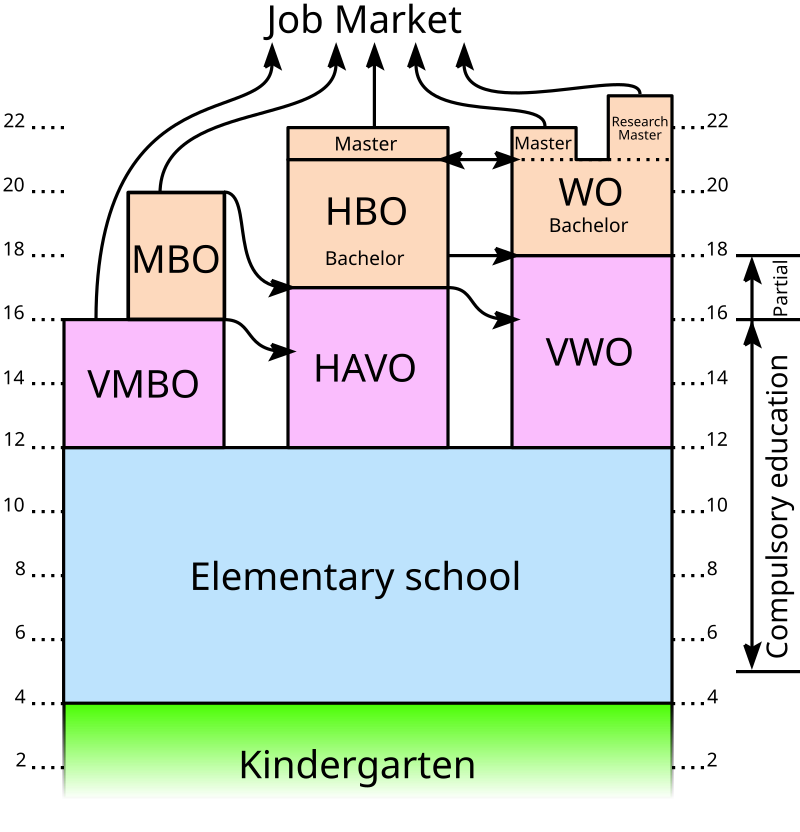
The Dutch education system is divided into several stages:
- Primary Education (Basisonderwijs): Ages 4-12
- Secondary Education (Voortgezet Onderwijs): Ages 12+
- VMBO (Vocational Training)
- HAVO (General Secondary Education)
- VWO (Pre-University Education)
- Vocational and Higher Education:
- MBO (Middle-Level Applied Education)
- HBO (Higher Professional Education)
- WO (Research Universities)
Education in the Netherlands is compulsory from age 5 to 18, and most schools are publicly funded, making them free or low-cost.
2. Primary Education (Basisonderwijs)
Structure and Curriculum
- Ages: 4-12 (8 years)
- Focus: Core subjects like Dutch, math, science, and English (introduced in later years). Schools also emphasize creativity, physical education, and social skills.
- Assessment: Continuous assessment with a national test (CITO) in the final year to determine secondary school placement.
Choosing a Primary School
- Public Schools: Free and open to all children.
- Religious Schools: Often Catholic or Protestant, but open to children of all backgrounds.
- Alternative Schools: Such as Montessori or Dalton schools, which focus on individualized learning.
- International Schools: Offer curricula in English or other languages, ideal for expat families.
3. Secondary Education (Voortgezet Onderwijs)
VMBO, HAVO, and VWO Explained
At age 12, students are placed into one of three tracks based on their academic performance and teacher recommendations:
- VMBO (Voorbereidend Middelbaar Beroepsonderwijs):
- Duration: 4 years.
- Focus: Vocational training and practical skills.
-
Pathways: Leads to MBO (middle-level applied education) for careers in trades, healthcare, or technology.
-
HAVO (Hoger Algemeen Voortgezet Onderwijs):
- Duration: 5 years.
- Focus: General education with a mix of theory and practice.
-
Pathways: Leads to HBO (higher professional education), similar to a university of applied sciences.
-
VWO (Voorbereidend Wetenschappelijk Onderwijs):
- Duration: 6 years.
- Focus: Academic and theoretical education.
- Pathways: Leads to research universities (WO) for careers in law, medicine, engineering, or academia.
Choosing a Secondary School
- Consider your child’s academic strengths and interests.
- Visit schools and talk to teachers and students.
- Check school performance and reputation.
4. Vocational and Higher Education
MBO (Middle-Level Applied Education)
- Duration: 2-4 years.
- Focus: Vocational training for specific careers.
- Pathways: Graduates can enter the workforce or continue to HBO.
HBO (Higher Professional Education)
- Duration: 4 years.
- Focus: Applied sciences and professional training.
- Pathways: Graduates can enter the workforce or pursue a master’s degree at a research university.
WO (Research Universities)
- Duration: 3 years for a bachelor’s degree, 1-2 years for a master’s degree.
- Focus: Academic and theoretical research.
- Pathways: Graduates can pursue careers in academia, research, or professional fields.
5. International Schools in the Netherlands
International schools offer curricula such as the International Baccalaureate (IB), British GCSE/A-Levels, or American High School Diploma. These schools are ideal for expat families who want continuity in their child’s education.
- Pros:
- Instruction in English or other languages.
- Globally recognized qualifications.
- Easier transition if moving to another country.
- Cons:
- High tuition fees.
- Limited integration into Dutch society.
6. Key Considerations for Expats
- Language: If you plan to stay long-term, learning Dutch is crucial for integration and accessing Dutch schools.
- Duration of Stay: If your stay is temporary, international schools may be a better fit.
- Cost: Dutch schools are free, while international schools can be expensive.
- Child’s Needs: Consider your child’s academic strengths, interests, and adaptability.
7. Conclusion
The Dutch education system offers a variety of high-quality options to suit every child’s needs and aspirations. Whether you choose a Dutch school for integration or an international school for continuity, the Netherlands provides an excellent foundation for your child’s future. Take the time to explore your options, visit schools, and talk to other expat families to make the best decision for your child’s education.
Good luck with your journey through the Dutch education system!